Studio Space rental guide

by Emily Zhang
· 11 min read
Open your timetable and count the hours where the studio is open but nothing is scheduled. For most movement studios the answer sits somewhere between 15 and 30 hours a week — weekday mornings, the three-to-five slump, the gap after the evening classes end.
Rent gets paid on those hours. So does electricity. So does insurance.
If half of them went out at NT$600 an hour, that's roughly NT$36,000 a month — without teaching an extra class, hiring anyone, or spending a dollar on marketing.
It's capacity you've already paid for and haven't sold.
Here's how to sell it, and where it usually goes wrong.
✅ First: find out how much idle time you actually have
Most owners underestimate this, because the impression comes from the busy hours rather than the data.
Pull your real utilisation — not what's on the timetable, but which slots actually have people in them. A class that's been running with three attendees for six months is, in floor-space terms, close to empty.
Then sort the gaps into three kinds:
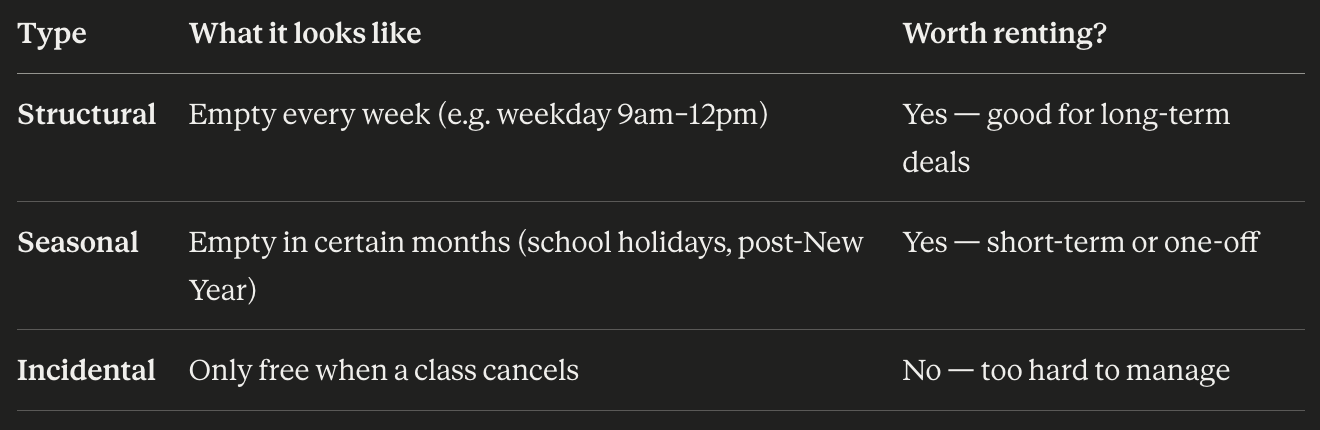
Stick to structural gaps. Incidental ones look like revenue but cost more in coordination than they return.
📝 Who rents studio space
Two types of tenant, with different needs and different risks.
Freelance trainers bringing their own clients are the bulk of the market. Their numbers have grown sharply in recent years: they have clients and expertise but no space. They want a fixed slot, use it frequently, and often commit for months — which makes cash flow predictable and scheduling easy. The thing to think through is that their clients will be in your space without being your members.
Other studios or brands running events book in bursts — teacher training, brand workshops, one-off intensives. Shorter, less predictable, but you can charge more per hour, and it turns off-peak time into premium time. Expect larger groups and heavier wear on the space.
Price and manage these two separately. They use the space in completely different ways.
📝 Three ways to price it
- By the hour or by the slot. Simplest, best for one-offs. Work out your allocated cost (monthly rent ÷ usable monthly hours), then mark up — most studios land at two to three times cost. Price peak and off-peak differently; charging the same for Tuesday 10am and Saturday 2pm means underselling your best hours.
- Monthly, for a fixed slot. The tenant buys, say, Tuesday and Thursday mornings, and pays monthly. Unit price typically runs 15–25% below the hourly rate, and you get predictable cash flow and stable scheduling in exchange. This is what most freelance trainers want, and it's the easiest arrangement to administer.
- Revenue share. Tempting in theory, difficult in practice — you'd need visibility into what the tenant actually collects, which means either touching their payment process or trusting self-reporting. Not recommended unless the relationship is unusually close.
📝 Scheduling: where this usually breaks
This is the most common failure we see, and the main reason studio rental arrangements fall apart.
For example: A client running their own group classes and renting the same space to outside trainers. Initially their own timetable lived in the system while rental slots were tracked separately. The outcome was predictable: one Wednesday morning, an in-house private session and a tenant's class were booked into the same room. Both sets of clients turned up.
Once is enough to do damage. The tenant questions your professionalism; your members decide the studio is disorganised.
The cause isn't carelessness — it's two records that don't share a timeline. As long as rental slots live outside the scheduling system, manual cross-checking will fail eventually. Not whether, just when.
📝 Three things that work:
- Rental slots have to consume real scheduling capacity. Not a note saying "rented" — the system needs to treat that space as occupied so in-house classes can't be booked into it. In practice, that means building rental slots as a class or booking item so they occupy the room like anything else, and conflicts get blocked at the point of scheduling rather than discovered on the day.
- Shared spaces need allocation rules. With multiple rooms, or one room that can be divided, define explicitly which combinations can coexist and which are mutually exclusive. The same logic that prevents double-bookings in your own classes applies to rentals — one set of rules, not two.
- Build in buffers. Cleaning, resetting equipment, clearing the floor. Fifteen minutes minimum between bookings, thirty at peak. A lot of conflicts aren't overlapping bookings — they're bookings scheduled too tightly.
✅ Getting paid: the second thing that breaks
Scheduling errors are obvious. Billing errors are slow — you usually find them at month-end, or later.
Three common gaps:
- Rental income never enters the system. The tenant transfers money or pays cash, and it gets logged in a chat thread or a notebook. At month-end you have two separate sets of books and can't easily answer "what did we take this month?"
- Deposits go untracked. You took a deposit but there's no clear record of whose, how much, or when it's returnable. Disputes follow, especially if admin staff have changed in between.
- Prepaid hours drift. The tenant bought 20 hours and has used 13. When do the remaining seven expire? Who's tracking it? Same problem as class-pass balances, but with bigger amounts and a fellow professional on the other side.
📝 What to put in place:
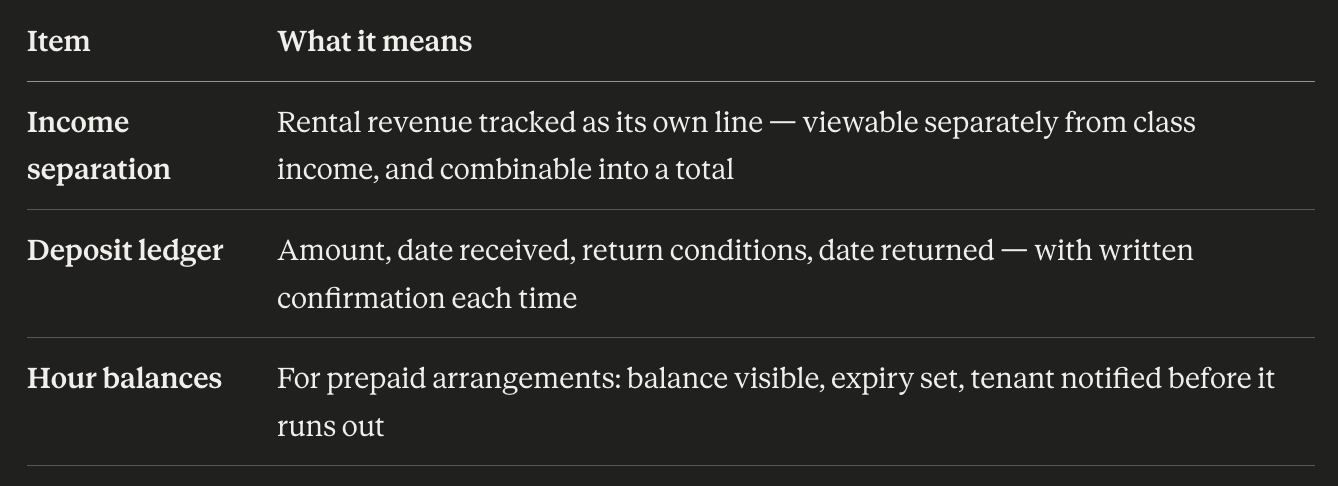
The practical move is to treat tenants as a special kind of customer inside your system rather than keeping a separate spreadsheet. They have contact details, transaction history, and prepaid balances — structurally the same as a member. Tagging them as their own group lets you split rental income from class income in reporting while still seeing the combined total.
📝 Agree these before you start
These rarely blow up, but sorting them out takes ten minutes and saves considerably more later.
- Equipment. What's included, what's off-limits, who replaces consumables. Worth listing explicitly for higher-value equipment like reformers or racks.
- Whose clients are they? The tenant's clients are in your space — are they your customers? Can they receive your marketing? Do they get member pricing? There's no standard answer, but there does need to be an agreed one. Most studios settle on: normal service in the space, no direct marketing to the tenant's clients.
- Promotion. Can the tenant put up posters, hand out flyers, shoot promotional content, tag your location on social media?
- Insurance and liability. If the tenant's client is injured in your space, where does responsibility sit? Worth asking your insurance broker — coverage varies significantly between policies.
- Notice period. Monthly arrangements need at least a month's notice, or you'll lose a slot with no time to fill it.
📝 Pre-agreement checklist
✔️ Scheduling
🔸 Fixed slot or flexible booking?
🔸 Start and end times, including setup and clear-down
🔸 Cancellation rules and deadlines
🔸 What happens on public holidays and closures
✔️ Money
🔸 Pricing basis (hourly / monthly / prepaid hours)
🔸 Payment cycle and method
🔸 Deposit amount and return conditions
🔸 Late payment handling
✔️ Space
🔸 Which areas are included
🔸 Which equipment is available
🔸 Cleaning and reset standards
🔸 Maximum group size
✔️ Responsibility
🔸 Status of the tenant's clients
🔸 Limits on promotion and recruitment
🔸 Insurance and liability
🔸 Notice period
🔸 Is this right for your studio?
⚠️ Three situations where I'd say hold off.
- Your timetable is already full. Marginal revenue is low, management cost is real.
- Your brand is deliberately closed. For some boutique studios, "only our classes happen here" is part of the value. Opening the space dilutes it.
- You don't yet have scheduling under control. This is the important one. If coordinating your own timetable already relies on manual checking, adding rentals doubles the mess. Get scheduling solid first, then rent.
Otherwise — with stable structural gaps, one system managing all your time slots, and ten minutes spent agreeing terms — this is one of the few ways a studio can add revenue without adding work.
❓ Frequently asked questions
👉🏻 Will renting to trainers cost me clients? Less often than owners fear. Tenant trainers bring their own existing clients, and the two groups usually don't overlap. What actually needs settling is whether their clients can receive your marketing — agree the boundary and the concern mostly goes away.
👉🏻 What should I charge per hour? Start with allocated cost (monthly rent ÷ usable monthly hours), then mark up based on peak/off-peak and tenant type. Two to three times cost is a common landing point, but location, equipment quality, and local competition move the number a lot — check what comparable spaces nearby are charging.
👉🏻 Do I need a formal contract? For monthly or long-term arrangements, yes. For one-offs, at minimum a written set of terms — a single page covering times, fees, equipment scope, and liability. Verbal agreements are worth nothing at the point they're needed.
👉🏻 How do I stop rental slots clashing with my own classes? Both have to live in the same scheduling system, with rental slots genuinely occupying the space rather than sitting in a separate note. Any two-record setup will eventually fail a manual cross-check.
📝 Want to get this organised?
What rentals actually require is that slots can't clash and income is visible, which is what the scheduling and booking modules already do. In practice, studios build rental slots as a class or booking item: once a slot is occupied, in-house classes can't be scheduled into it, and the conflict is caught when you schedule rather than on the day. Tag tenants as their own group and rental income separates out in your reports.
Put differently — you don't need a new feature. You need rental slots and your own classes living on the same timeline.
We currently serve around hundreds of studios and venues, with no transaction commission and no setup fee. Signing up includes an online training session.
👉 Start a 7-day free trial, or talk to our agent
If you're comparing pricing across systems, we've also broken down how booking system costs actually add up.
Was this article helpful?