How Studios Keep Summer Trial Clients After the September Term Starts

by Emily Zhang
· 11 min read
July and August are the busiest months of the year for a lot of movement studios. Summer promotions, trial pricing, students on holiday, parents looking for something to keep their kids occupied. The booking sheet fills up and everything looks healthy.
Then September arrives.
Your regulars are still there. But the new faces from July and August stop showing up, one by one. By the end of September, the retention rate on those summer clients is well below what you expected.
Most studios explain this the same way: "Summer clients are always like that. They were just trying something new."
That's half right. It misses the more important half.
💙 Summer clients don't disappear — their identity changes
The university student who took a trial class in July is still checking in at the café down the street in late August, still posting about the first day of term in September. She hasn't left town. She hasn't stopped exercising.
She has simply gone from being "a student on holiday with plenty of time" to "a student with a timetable."
The same shift happens to every kind of summer client:
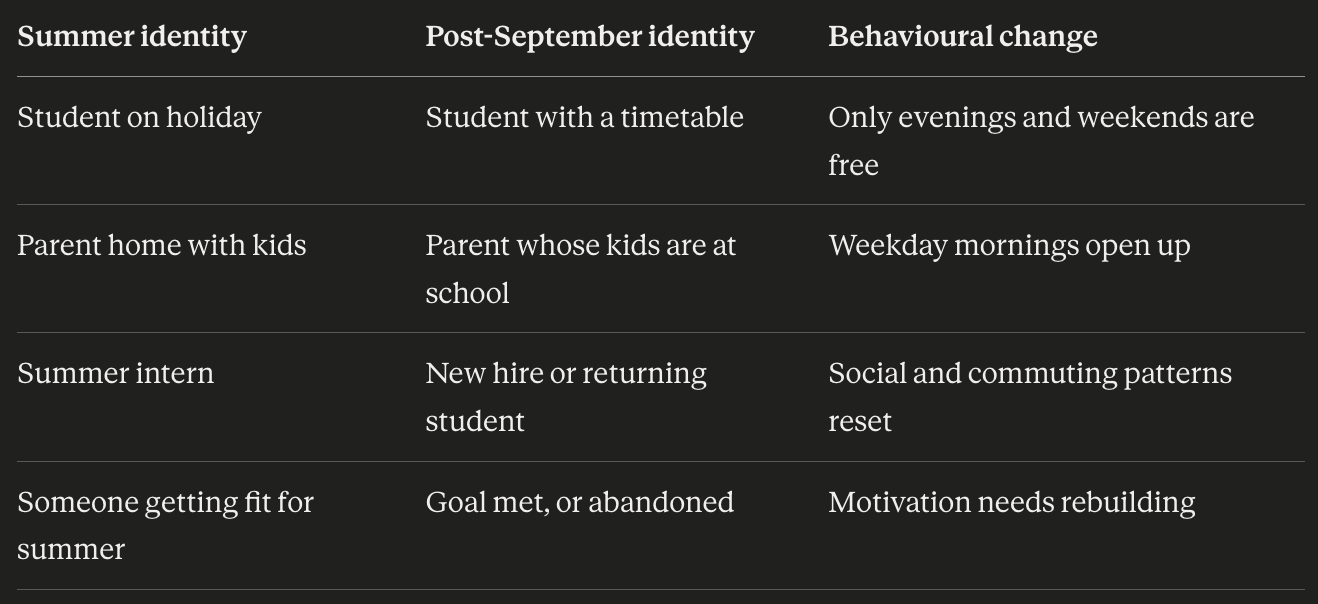
👉🏻 Here's the crux: these people don't not want to come. The slot they used to come in no longer exists, your timetable hasn't changed to match, and nobody has told them there's another option.
So they quietly stop. Not a decision to leave — just never being reminded to return.
👉🏻 The identity transition is a window for building long-term members, not a cause of churn. Catch it, and this person becomes someone who says "I've been going to that studio since I was a student." Miss it, and next time they think about exercising, they'll look for a studio that fits who they are now.
That window runs roughly four weeks, from late August to the end of September.
💡 Touchpoint one: 14 days before the pass expires (25 Aug – 5 Sep)
Most studios reach out after the pass expires: "Your pass has expired — would you like to renew?"
Two problems with that timing. First, the moment a pass expires, the client's mental state is "that's finished" — restarting is harder than continuing. Second, summer passes tend to expire in a cluster around late August and early September, so waiting until expiry means landing in their inbox during the busiest week of their year.
Reach out 14 days early and you're talking to someone who is still taking classes, not someone who has finished taking classes. The gap in renewal intent between those two states is significant.
Don't just write "your pass is expiring soon." That sentence delivers nothing but bad news. An effective version does three things:
- Reflects what they achieved — "you came to 8 classes this summer" makes the accumulation visible
- Names what's about to change — "the timetable shifts after term starts; we've added a 7pm slot"
- Gives a specific next step — not "renewals welcome," but "autumn term opens 1 September, here's the schedule"
On the system side, Omcean Booking's pass expiry reminders can be set to fire a set number of days before expiry, so nobody has to watch a list manually. Delivering via app push or LINE gets far better open rates than email.
If you want to say something different to summer clients specifically, use tags to mark everyone who joined in July and August, then use group messaging to separate the two conversations. Long-standing regulars and brand-new summer clients shouldn't be receiving the same message.
💡 Touchpoint two: the first week of term (1 – 7 Sep)
During the first week of term, your clients are actively rebuilding their routines. Apart from Lunar New Year, this is the point in the year when people are most willing to restructure how they spend their time.
This week's message shouldn't be "come back to class." It should be "here's how the new term works."
The difference matters: the first asks them to return to an old habit, the second participates in the new one they're currently building.
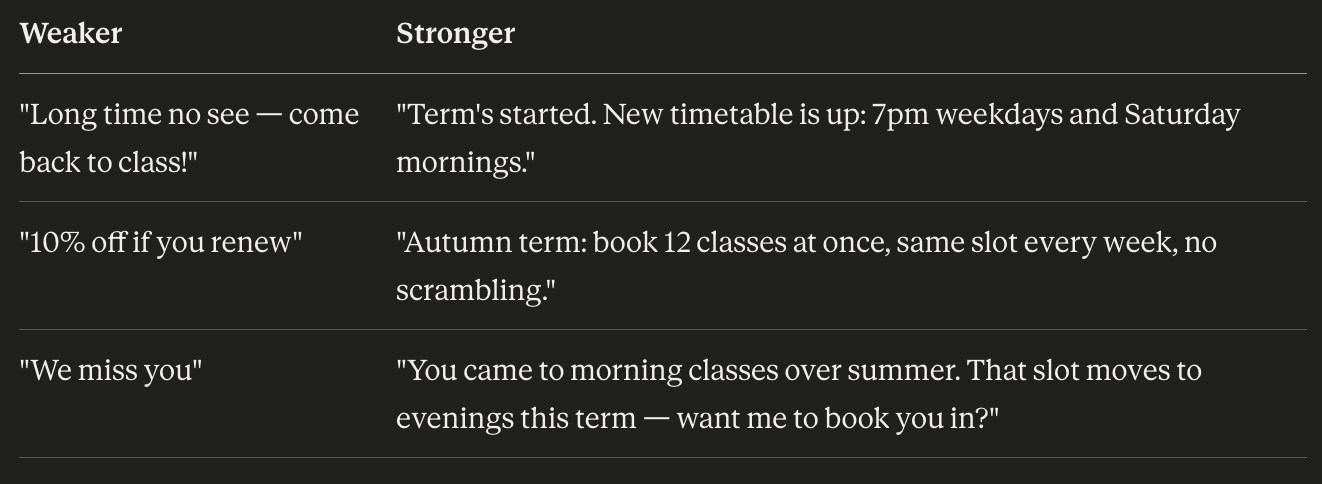
The third one requires knowing which slot they used to attend. That's the value of good records, not clever copywriting.
Timetables should also shift with the identity change. If a large share of your summer clients were students or parents, September's structure needs to move: student clients free up in the evenings and empty out during the day; parent clients do the opposite, with weekday mornings between 9 and 11 becoming their most available window; working professionals aren't affected much by term dates, but September carries the strongest "fresh start" psychology of any month outside January, which makes it a good time to launch a new class format.
Worth looking at your actual attendance data in late August before setting this, rather than going on impressions.
For the new autumn timetable, repeating classes let you schedule a whole term in one pass instead of adding classes week by week. And if you have parents booking for children, linked customer accounts let a parent book for their child from their own account without a second registration — particularly useful in September, when parents have the least patience for setting up another login.
💡 Touchpoint three: the 30-day quiet list (20 – 30 Sep)
After the first two touchpoints, a group will still have taken no action. They haven't said they're not coming. They haven't replied. They're just quiet.
This is the most valuable list you'll have at the end of September, for a simple reason: their last visit was only a month ago. The memory is still there, and restarting costs far less than acquiring someone new.
Most studios never work this list, because these people don't appear prominently on any report. They're not churned yet — not long enough gone for that — and they're not active either.
The filter is straightforward: last visit between 25 and 35 days ago, with pass credit remaining or recently expired.
Omcean Booking's reports and dashboard show attendance and booking trends, and the class attendance list helps you assemble the names. Once you have them, mark them with a tag so the same process is repeatable every month.
This group doesn't respond well to promotional messaging, because they aren't holding out for a discount. What works better is a low-commitment way back in: a single drop-in class with no pass purchase required; a newly opened slot, which gives them a reason it's different this time; or a direct question — "Has the new term made it hard to find a time? We've added a few slots, want to take a look?"
If you do want to use an incentive, coupon and referral codes can be issued to a specific list rather than discounting for everyone. Discounting people who were already going to buy is pure margin loss.
💡 Building an autumn term that can actually catch them
All three touchpoints assume one thing: that there's something in September to catch them with. If the timetable is identical to July and August, every message above loses its credibility.
September is the best month of the year to sell a full-term package, because people are actively planning new routines and are more willing to commit further out. The benefits run both ways: revenue lands upfront, attendance is higher than drop-in (people who have already paid tend to show up), and scheduling can be planned in advance. Omcean Booking's term-based classes let you package a full term as a single product, so a client books once and their whole term is set.
Open enrolment one to two weeks before term starts — so, late August. Any earlier and clients aren't thinking about September yet; any later and their time is already committed elsewhere. On the customer side, multi-class booking lets them drop the whole term into their calendar in one go, removing the weekly friction of remembering to book.
Demand in September concentrates into a handful of slots — usually weekday evenings and Saturday mornings. Rather than letting a client hit "fully booked" and leave, open a waiting list. Cancellations backfill automatically, so you're not handling it manually and the spot doesn't go empty.
💡 All of this rests on three fields
Looking back, everything above is built on three pieces of data:
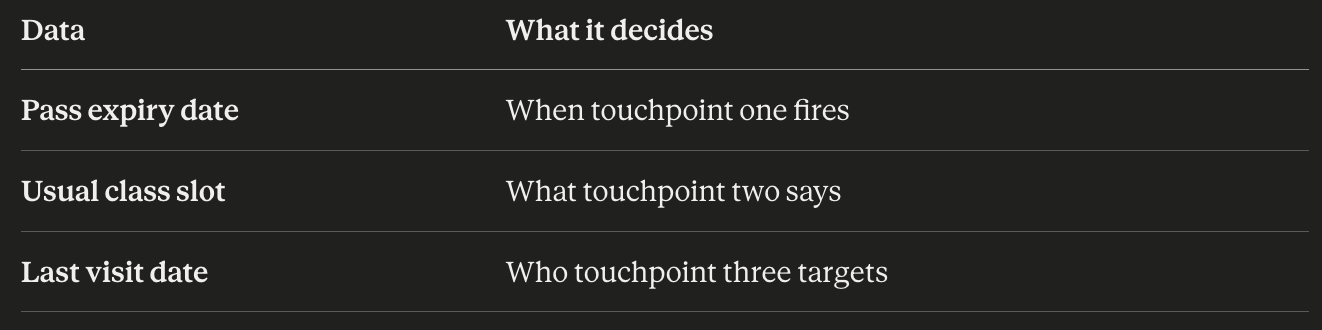
If those three currently live across LINE conversations, a spreadsheet, and your memory, then September isn't a question of executing well — it's a question of whether execution is possible at all, because assembling the list alone will consume half the month.
Which is why retention is less a marketing problem than a data structure problem. Writing a good message isn't the hard part. Knowing who to send it to, and on which day, is.
💡 September execution timeline
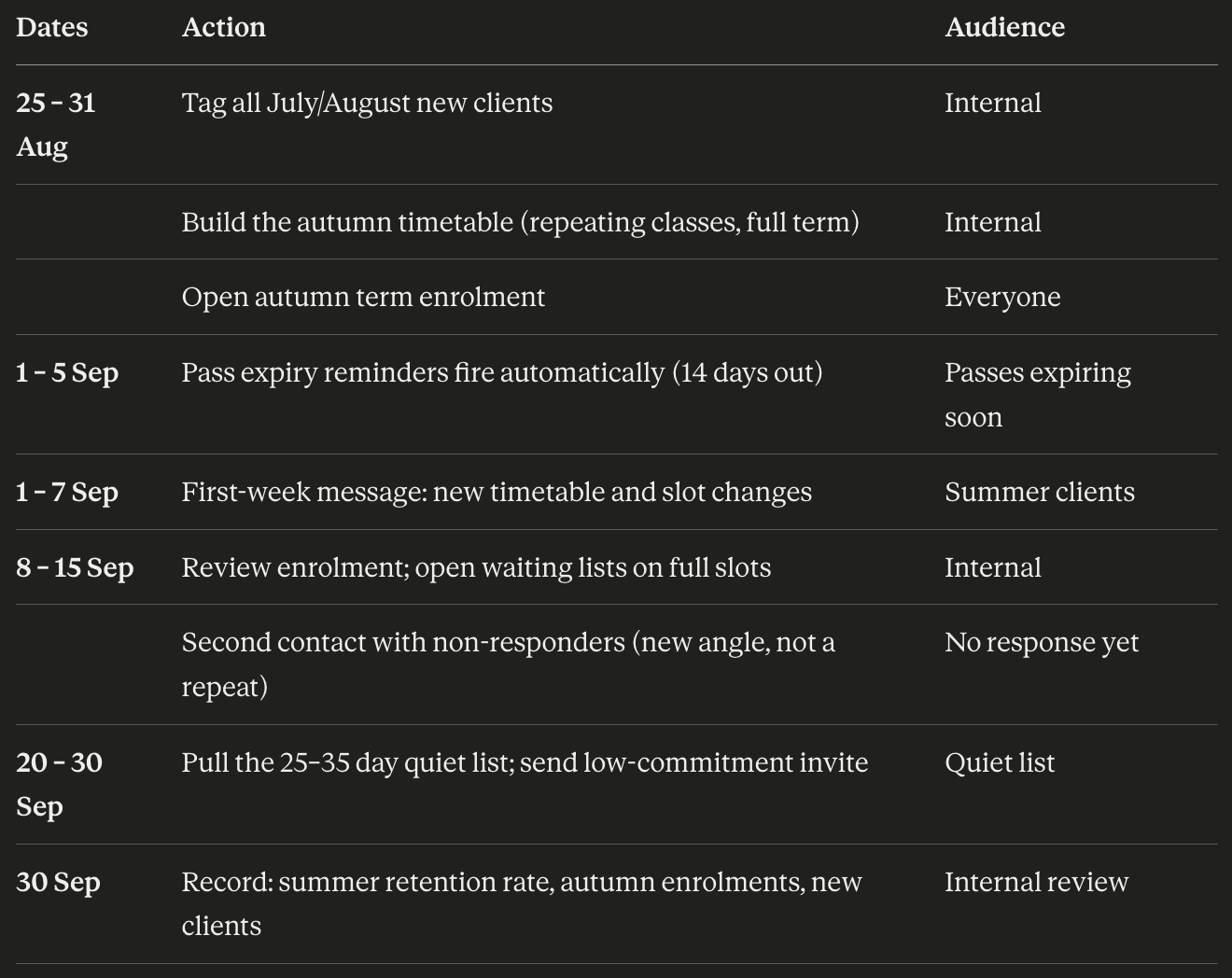
That last row matters. If you don't record the outcome, next year you'll be guessing from impressions again. Keep this year's numbers and you'll have a baseline — and a way to tell which touchpoint actually worked.
✏️ Frequently asked questions
What's a normal retention rate for summer trial clients? It varies enormously by class type, price point, and client mix, so there's no universal benchmark. Rather than chasing an external number, record your own studio's figure this year and use it as next year's baseline. Retention numbers are meaningful as a trend, not as an absolute.
Will this many messages annoy clients? Frequency isn't really the issue — usefulness is. Three touchpoints spaced roughly two weeks apart, each carrying different information (expiry notice, new timetable, re-invitation), isn't heavy. What genuinely annoys people is receiving the same promotional message repeatedly.
Does the school term matter if my clients aren't students? Yes, but differently. Parent clients gain free time in September rather than losing it. Working professionals are influenced by the "fresh start" effect, which makes September one of the few months where new habits form easily. The point is to match your message to their identity shift, not to copy the student playbook.
Can I just do this manually? Under a hundred clients, yes — it's doable. But the value of this process is in repeating it every term. A first manual pass might take three hours; repeated quarterly, that's twelve hours a year. Automation isn't there to replace your judgement, it's there so you don't rebuild the list from scratch every time.
Want to set this up?
Omcean Booking currently serves around 600 movement studios and venues. The pass expiry reminders, tagging, term scheduling, and waiting lists described above are all built in.
We take no transaction commission and charge no setup fee. Signing up includes one online training session, where we can help you configure your autumn timetable and automated reminders in one sitting.
👉 Start a 7-day free trial, or talk to our team
If you're comparing pricing across systems, we've also written a breakdown of how booking system costs actually add up — subscription, commission, and notification costs, separated out.
Was this article helpful?